Almost every HubSpot partner site has a stats section. Ours did too, scattered across half a dozen pages: 107% more leads here, 76% higher close rates there, 13x faster ticket resolution somewhere else. All of it real. All of it pulled from HubSpot's own published research. And all of it presented the way most partner sites present it — stripped of context, sitting next to a "Free Audit" button, doing more to sell HubSpot than to tell you anything useful.
Here's the fuller picture: every number we could find, organized by team, with the source attached, the methodology behind it, how it stacks up against the broader CRM category, and — most importantly — what it actually means for a business trying to figure out what results are realistic for them specifically.
The Headline Numbers
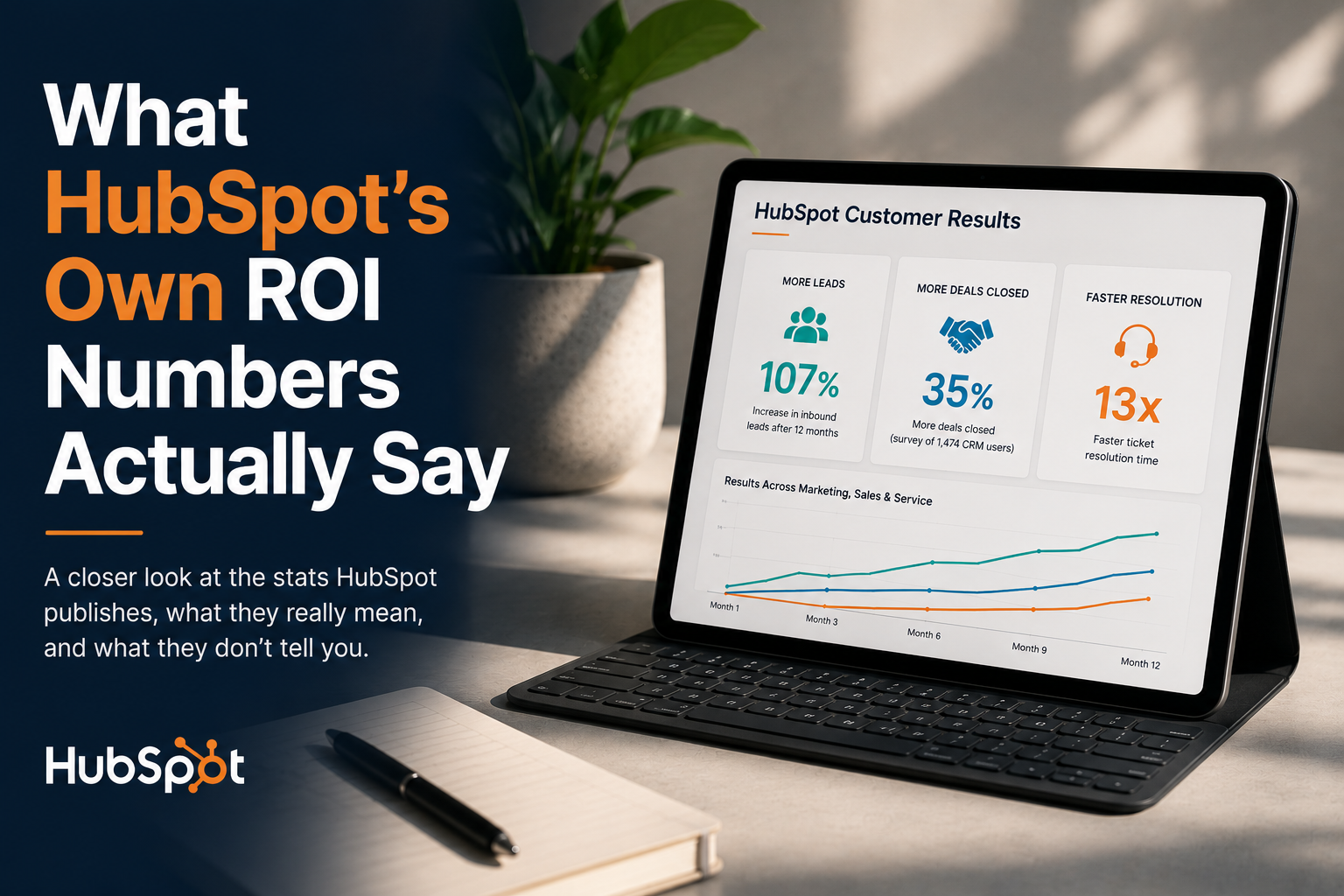
If you've spent any time looking at HubSpot's own marketing, three stats show up more than any others, because they're the ones HubSpot leads with:
- 107% more leads generated by customers who've owned a Marketing Hub plan for at least 12 months, measured by monthly form submissions
- 35% more deals closed, based on a survey of 1,474 CRM users worldwide conducted in August 2024
- 28% increase in ticket resolution rate for customers using Service Hub
These three numbers get the most airtime because they're the easiest to say out loud in a sales conversation — one for marketing, one for sales, one for service. They're legitimate, they come from HubSpot's own 2024 Annual ROI Report, and they're a reasonable starting point for what's possible. They're also the tip of a much larger dataset, most of which never makes it onto a partner's homepage.
Where These Numbers Actually Come From
HubSpot publishes an annual ROI report based on surveys and product usage data from its own customer base. That's worth sitting with for a second: some of these figures — like the 107% lead increase — are measured directly from product data (monthly form submissions, compared before and after adoption). Others — like "76% of marketing leaders say HubSpot increased their conversion rate" — are self-reported survey answers, a perception-based claim rather than a controlled before-and-after measurement. The 35% more-deals-closed figure, for instance, comes from a survey of 1,474 CRM users conducted in August 2024, not a product-usage audit.
Both types of data are useful, but they're not the same type of claim, and most places that publish these stats don't bother distinguishing between them. It's also worth remembering these figures are averaged across an enormous, wildly diverse customer base — from single-person startups to enterprise sales orgs — which flattens out a lot of the real variance in outcomes. None of that makes the numbers fake. It just means they're a starting point for a conversation, not a promise, and it's worth knowing which kind of number you're looking at before you build a business case around it.
The Marketing Numbers
- 76% of marketing leaders say HubSpot increased their conversion rate
- 82% of marketers report that HubSpot increased their lead generation
- 107% increase in inbound leads among Marketing Hub customers, after 12 months
- 134% increase in website traffic reported by Marketing Hub customers
- 76% higher deal close rate among Marketing Hub customers
- 21% increase in deals created among Marketing Hub customers
Read together, these tell a fairly coherent story: Marketing Hub customers see more traffic, more of that traffic converts to leads, and more of those leads eventually close. That's the funnel working the way it's supposed to. What the aggregate stat doesn't show is how much of that lift depends on what's actually being published and how well the lifecycle stages are defined underneath it — a business running the same software with no defined lead-to-customer path won't see the same curve.
The Sales Numbers
- 84% of sales leaders say HubSpot improved their lead quality
- 31% more deals closed among customers using the full CRM platform versus Sales Hub alone
- 28% more deals created among Sales Hub customers, after 12 months
- 55% more deals closed among Sales Hub customers
- 128% more meetings attended among Sales Hub customers
- 35% more deals closed overall, per the August 2024 survey of 1,474 CRM users
Notice the 31% figure specifically: customers running the full CRM platform (marketing, sales, and service together) closed more deals than customers running Sales Hub in isolation. That's HubSpot's own data making the case for its own core premise — that the value comes from the connected system, not any single Hub in a vacuum. It's a useful data point if you're deciding whether to buy one Hub or several, and it lines up with what we see in practice: sales performance is rarely just a sales problem. Deal velocity is often throttled by how well-qualified the leads were coming in, which is a marketing and lifecycle question as much as a sales one.
The Service Numbers
- 77% of service leaders say HubSpot increased customer lifetime value
- 28% increase in ticket resolution rate among Service Hub customers
- 13x faster resolution time among Service Hub customers
- 42% more tickets closed per agent among Service Hub customers
- 84% report increased CSAT among Service Hub customers
Service often gets the least attention in these conversations, but the numbers here are arguably the most operationally significant for growing teams: 42% more tickets closed per agent is a direct headcount-efficiency number, not just a satisfaction score. If a support team is drowning in ticket volume, this is the category of number worth pressure-testing against your own case, since it maps to a very concrete cost — how many more reps you'd otherwise need to hire.
The Platform-Wide Numbers
- 72% say integrating data with HubSpot is easy
- 79% say the CRM platform helps centralize their data
These two are less flashy than the funnel and deal numbers, but they're arguably the most foundational, because they speak directly to the thing HubSpot's whole architecture is built around: one shared record instead of scattered systems. If your business is currently running four disconnected tools that don't talk to each other, these numbers describe the actual problem HubSpot's platform architecture is meant to solve — not a bonus feature, the core one.
All figures above are according to HubSpot's 2024 Annual ROI Report, unless otherwise noted.
How HubSpot's Numbers Compare to the Rest of the Category
It's worth stepping back from HubSpot specifically for a moment, because a healthy amount of this lift isn't unique to HubSpot — it's what a properly implemented CRM does in general, regardless of vendor.
Nucleus Research, an independent analyst firm that's tracked CRM return-on-investment for years, currently puts average CRM ROI at roughly $3.10 returned for every $1 spent — down from closer to $4.90 a decade ago, as deployments have become more complex and expectations have risen. Their research also attributes 51% of total CRM ROI to productivity and process-efficiency gains, not to lead generation or deal volume directly, which is a meaningfully different emphasis than most vendor marketing leads with.
Separately, Salesforce's own State of Sales research reports that sales teams using a CRM close roughly 26% more deals on average than teams without one, alongside a 29% increase in overall sales revenue and a 42% improvement in forecast accuracy.
The point of bringing in numbers from outside HubSpot isn't to undercut HubSpot's own report — it's to show that a meaningful share of "CRM ROI" is a category-wide effect, not something exclusive to one platform's marketing claims. What differentiates outcomes at that point isn't which CRM logo is in the corner of the screen. It's whether the system underneath it was actually built to match how the business operates.
What This Actually Means for You
The honest read: these numbers are directionally real, and worth taking seriously. HubSpot genuinely does move these metrics for a lot of companies, and the platform-wide numbers in particular — data centralization, ease of integration — reflect something true about how the tool is architected, not just a marketing claim.
But "customers who owned Marketing Hub for 12 months saw a 107% increase in leads" is a different claim than "you will see a 107% increase in leads." Averages hide range. Inside every one of these statistics is a distribution — some accounts saw far more than the average, some saw far less, and a meaningful number probably saw close to nothing. The businesses at the low end of that range weren't running worse software. In our experience, they were disproportionately the ones where the CRM foundation underneath the tool was never properly built: no real data model, no defined lifecycle stages, pipelines that didn't match how the sales team actually worked, reporting nobody trusted enough to act on.
Same software. Wildly different outcomes. The difference wasn't the software — it was everything underneath it. That's the entire argument behind what a CRM is actually supposed to do, and it's why we treat the data architecture as the real product, not the Hub tier someone happened to buy.
If you're evaluating HubSpot and trying to figure out what kind of results are realistic for your specific situation — not a stat pulled from an average of thousands of accounts you have nothing in common with — that's exactly the kind of thing a discovery call is for. See HubSpot Implementation if you're still deciding what to buy, or Revenue Operations if you're already on HubSpot and the results haven't matched the stats.
Sources HubSpot 2024 Annual ROI Report, HubSpot ROI Report Resources for Partners, Nucleus Research CRM ROI analysis, Salesforce State of Sales
.png)